

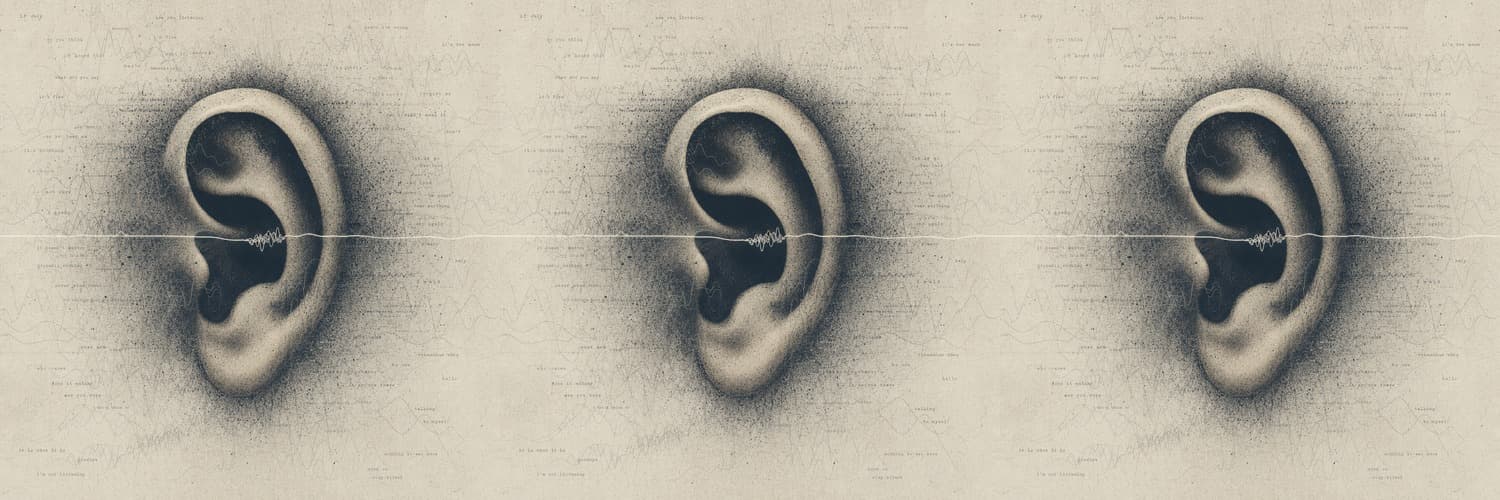
The cocktail party effect is usually told as a flattering story about focus: a loud room, twenty conversations, and somehow you hold the one voice in front of you. Proof of a good filter.
But in 1959 Neville Moray ran the experiment that complicates it. He played two messages, one into each ear, and told people to repeat back only the left. Most could discard the right ear completely — until he slipped their own name into it. About a third heard it anyway, mid-sentence, surfacing out of a channel they'd been instructed to ignore.
That's the part that stays with me. To catch your name in the ignored ear, something has to be reading the ignored ear. The filter isn't a wall, it's a volume knob. You're not blocking the rest of the room. You're listening to all of it, all the time, transcribing every conversation just well enough to check it against one word, then throwing the transcript away the instant it doesn't match.
So the attention you're proud of is the small process. The large one runs underneath it — tireless, unsupervised, reading the whole room and discarding almost everything it reads. You only ever meet it on the rare occasion it finds your name.