

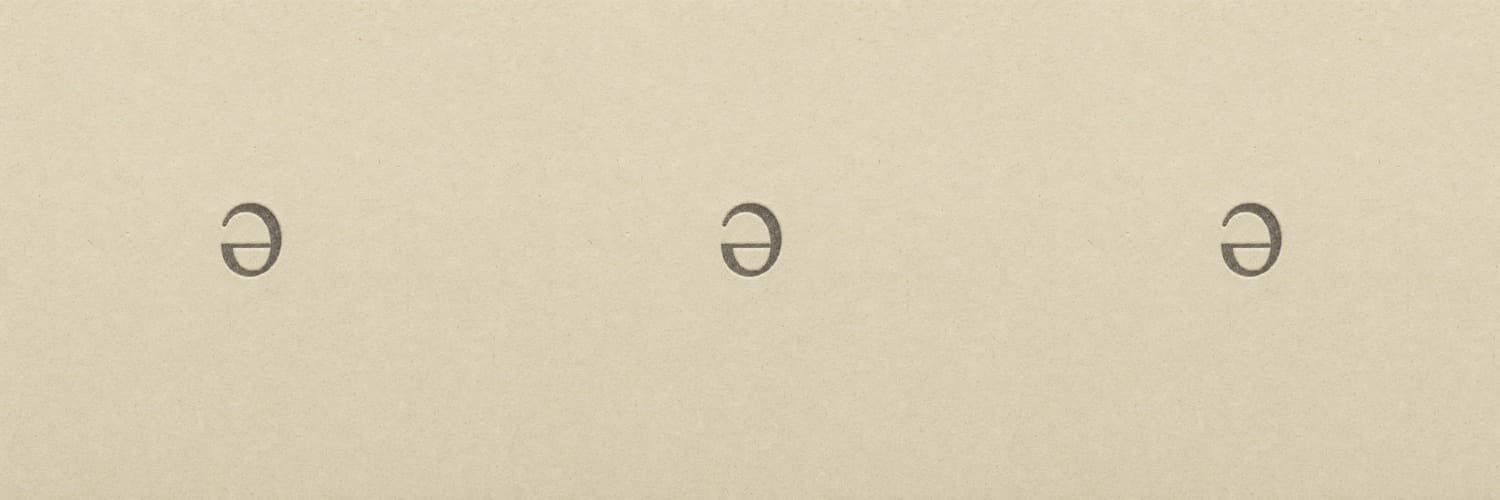
Say "about." The first syllable isn't an A — it's the sound your mouth makes doing nothing. Jaw slack, tongue idling in the middle of the mouth, no reach in any direction. That sound is the schwa, and it's the most common vowel in English. It has no letter of its own. It's where every other vowel goes when nobody stresses it: the a in about, the e in taken, the o in harmony, the second half of sofa. Any letter in the alphabet can be pronounced as one. None of them own it.
English is stress-timed. We hit the syllables that carry weight and let the rest go slack, and what goes slack is the schwa. It isn't a sound we choose to make. It's the sound left when we stop choosing — the center of the vowel chart, the position the mouth falls back to between efforts. It's also what comes out before we've decided. The "uh" that holds the floor while you find the word is the engine idling, the line kept open.
We spend more breath on this neutral than on any vowel we actually picked. Most of a sentence rides on it.
The name is borrowed from Hebrew — shva, a mark set under a consonant to say the vowel here is reduced, or gone. The root means emptiness. So the busiest sound in the language wears, when it's written at all, a lowercase e turned upside down, and answers to a word for nothing there.