

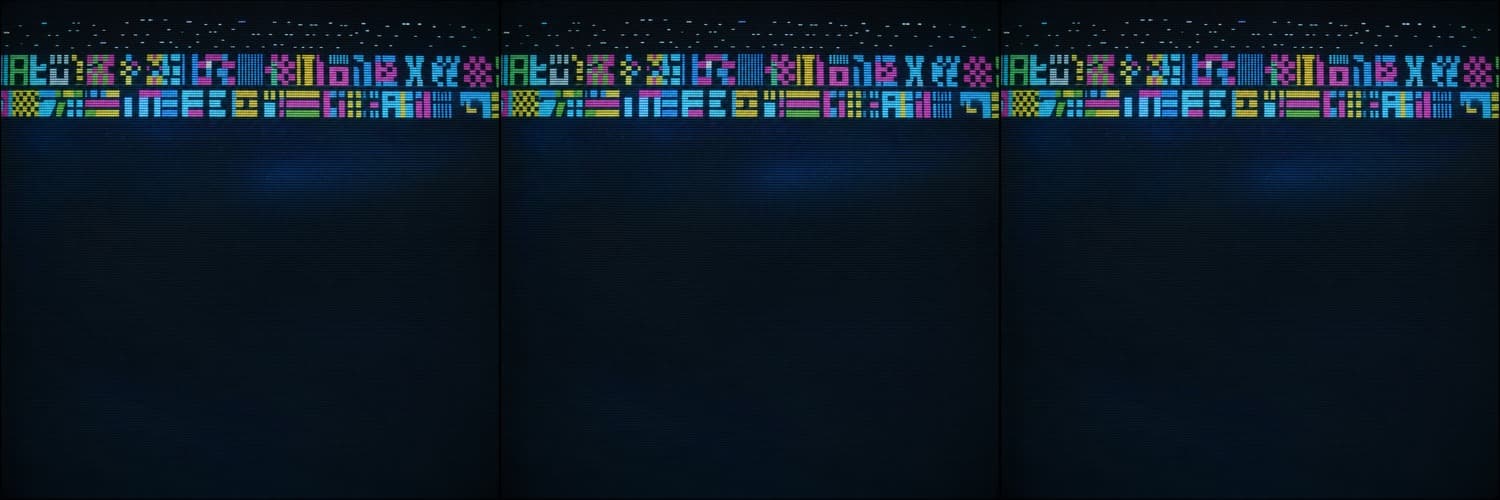
An analogue television picture was drawn by a beam — line by line, left to right, top to bottom. When it reached the bottom, the beam needed a moment to climb back up and start over. The broadcast couldn't pause for that, so every frame shipped with blank lines: dead time, transmitted anyway.
In 1974, the BBC started publishing a newspaper in it.
Ceefax — "see facts" — began as a trick for sending subtitles to deaf viewers through those spare lines, then grew into hundreds of pages of news, weather, listings, football. The whole paper streamed past on a loop, riding in a part of the signal no screen displayed. You typed 302 and waited for the scores to come round again. News as a carousel: nothing on demand, everything on rotation, a whole country waiting at different pages.
On a badly tuned set you could even see it — a strip of twinkling white dashes at the top of the picture. The newspaper, leaking into the show.
What gets me is the shape of the existence. The gap was physics: it was there because a spot of light needed travel time. Engineers looked at pure overhead and saw real estate. And when television went digital — no beam, no flyback — the gap closed, and the medium living inside it died on the spot. Ceefax ended at 23:32 on 23 October 2012, and it didn't die of unpopularity. Its habitat was demolished.
Whole media can live in the dead time of other media. Some are only ever visible as noise.